
Your Ultimate Guide on Kids Car Seats & Booster Seats in Singapore

The Importance of Child Car Seats
The seat belts in your car are designed for adults, not kids. Car seats work like adaptors together with the seat belts — they are specifically engineered to support the smaller frames and more delicate bodies of young children and babies.
In the event of an unfortunate accident, the car seats, or Child Restraint System (CRS), that you have in place will ensure that your kids are securely restrained, preventing them from being ejected from the vehicle. It will also help to distribute crash forces over the strongest part of their bodies, to mitigate injuries sustained.
Simply put, car seats keep your kids alive and safe. And they do a better job than you possibly can — children are safer buckled up in car seats than in your arms or on your lap. According to SingHealth, “using car seats from birth can reduce the risk of death and injury by up to 82%.”
Car Seat Requirements According to Singapore Law
There were almost 7,000 car accidents in Singapore in 2023 alone. To emphasise the importance of car seats, the Singapore Road Traffic legislation dictates that it’s mandatory for any “passenger below 1.35 metres in height… to be properly secured by approved child restraint… appropriate for a person of that height and weight.” Note: An “approved child restraint” refers to child car seats, booster seats or approved adjustable seat belts.
Technically speaking, as a motorist, you are not even allowed to be operating your motor vehicle if your little passenger isn’t correctly strapped in. If you’re found flouting this law, you could be fined up to $1,000 and/or face up to three months’ jail time, with repeat offenders getting heftier punishments.
Baby on Board: Upgrade Your Car Insurance Coverage
Investing in a child car seat and making sure that they are snugly strapped in is essential for their safety. What can also bring you peace of mind is adding an optional benefit so that your car insurance policy covers not just the driver but all other passengers’ medical expenses in the event of an accident, including all your children.
Safety Standards and Certifications
Singapore does not have its own car seat safety ratings standards. What is considered an “approved child restraint” in Singapore actually follows the International Safety Standards from the US, the UK, Europe, Australia and Japan.
Thus, when shopping for a car seat, look out for these certifications:
- The American Standard FMVSS 213
- British Standards B.S. 3254: Part 2: 1988
- British Standards B.S. AU 202a: 1988
- British Standards B.S. AU 185: 1983
- The European Standard ECE R44
- The Australian Standard AS 1754-1975 (including AS 1754.1-1989 Part 1, AS 1754.2-1989 Part 2 and AS 1754.4-1989 Part 4)
- The Japanese Standard JIS D0401-1990
These safety ratings are based on rigorous crash tests and standards, and should offer greater protection — but only if installed and used correctly.
4 Types of Car Seats
There are generally 4 types of child car seats available:
| Type of child car seat | Recommended for |
| Infant car seat / Baby capsule | Newborns up to 6 months |
| Rear-facing child car seat | Newborns up to 2 years |
| Forward-facing child car seat | 2 years to 5 years old |
| Booster seat | 5 years old to 12 years old |
Note, this is just a guide. You should always choose a car seat best suited for your child in particular, according to their height and weight, and safety considerations.
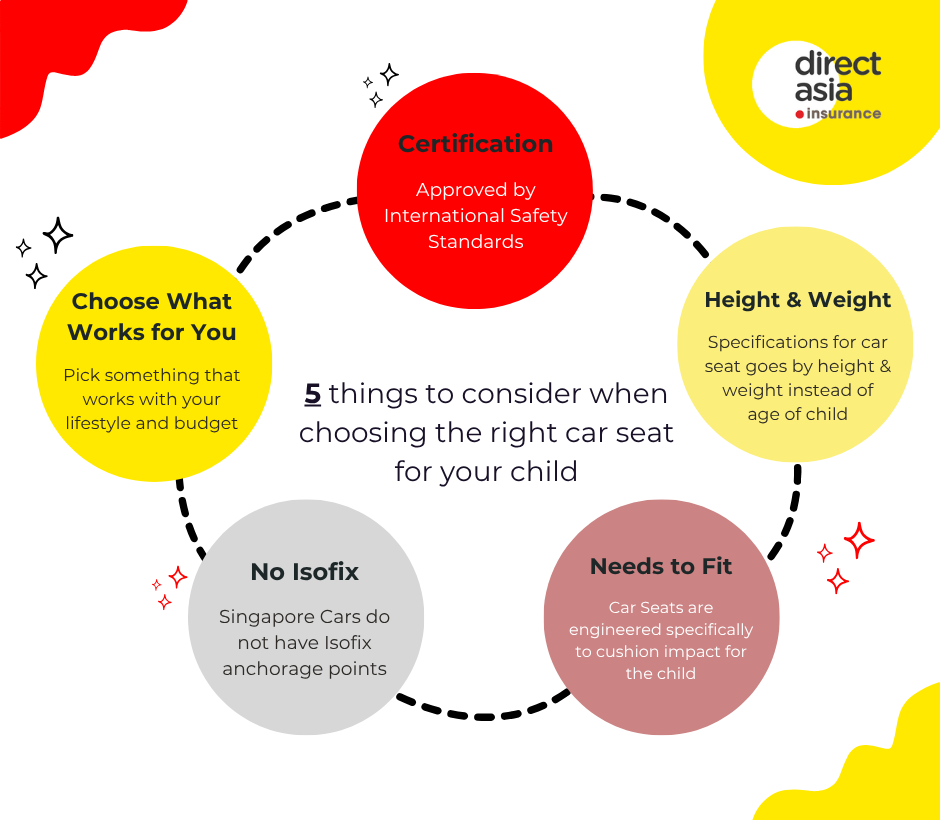
5 Things to Consider When Choosing the Right Car Seat for Your Child
Choosing the right car seat for your precious baby, toddler or child can be a difficult decision, especially with the options available on the market. Here are some factors to take into consideration when shopping for the right one:
The Front-facing vs Rear-facing Car Seat Debate
As long as your child is snugly secured in an approved car seat, does it matter if they’re in a rear-facing or front-facing car seat?
The answer is an overwhelming YES from many international safety experts and regulatory bodies. This recommendation is rooted in the anatomical vulnerabilities of infants and toddlers.
Numerous studies have shown that rear-facing seats provide better protection for the head, neck, and spine of young children, with some research indicating they are up to five times safer in the event of a collision.
When facing forward, a child’s head can be thrown forward with great force, placing immense stress on their neck and potentially leading to serious, sometimes fatal, injuries. Therefore, it is strongly recommended that young children remain in rear-facing car seats for as long as possible, until they’ve exceeded the height and weight limits set by the manufacturer for safety reasons.
5 Car Seat Mistakes to Avoid
Car seats can keep children safe — as long as they are being used correctly! Here are 5 car seat mistakes to avoid:
Putting children in the front passenger seat
According to the Traffic Police, “a child or person below 1.35 m should only ride in the rear seats to minimise the risk of injury in the event of an accident.”
KK Women’s and Children’s Hospital recommends that all “children 12 years old and younger should not sit in the front seat.” They also advise: “In the presence of an active air bag, never place a rear-facing car seat in the front seat of a car.”
Kids of all ages may really enjoy the view, but that same windscreen can be their undoing. In the event of an accident, the risk of a child being flung out of the windscreen is very high. If the front airbags are activated in a crash, the force generated upon deployment can result in fatality.
Baby-wearing in the car
You should never trust the safety of your baby in any kind of baby-wearing carrier or wrap, just as much as you should never have them in your arms or on your lap. They are only safe in an infant car seat.
Not reading the manufacturer’s manual
Car seats do not all work the same. Make sure you know exactly how your particular child seat works best.
Not tightening the harness straps
Strapping your child into their car seat correctly every time can be time-consuming, and in hectic paced-Singapore, it can be very tempting to leave it a little looser to make it easier and quicker.
Note that if it’s easier to slip your child in and out of their straps, then the straps are not doing their job at all. There should be no more than two fingers’ space above their shoulders.
Strapping a child in with additional bulk
The safety harness needs to be tightly strapped around your child. If they are wearing a bulky jacket, or there’s a support pillow behind them, or even a stuffed toy in front of them, all these can compress in an impact, causing slack in the harness and reducing its effectiveness.
If a child is cold, strap them into the harness first before putting a blanket over them. For this reason, you should also not swaddle a baby before putting them into their infant car seat.
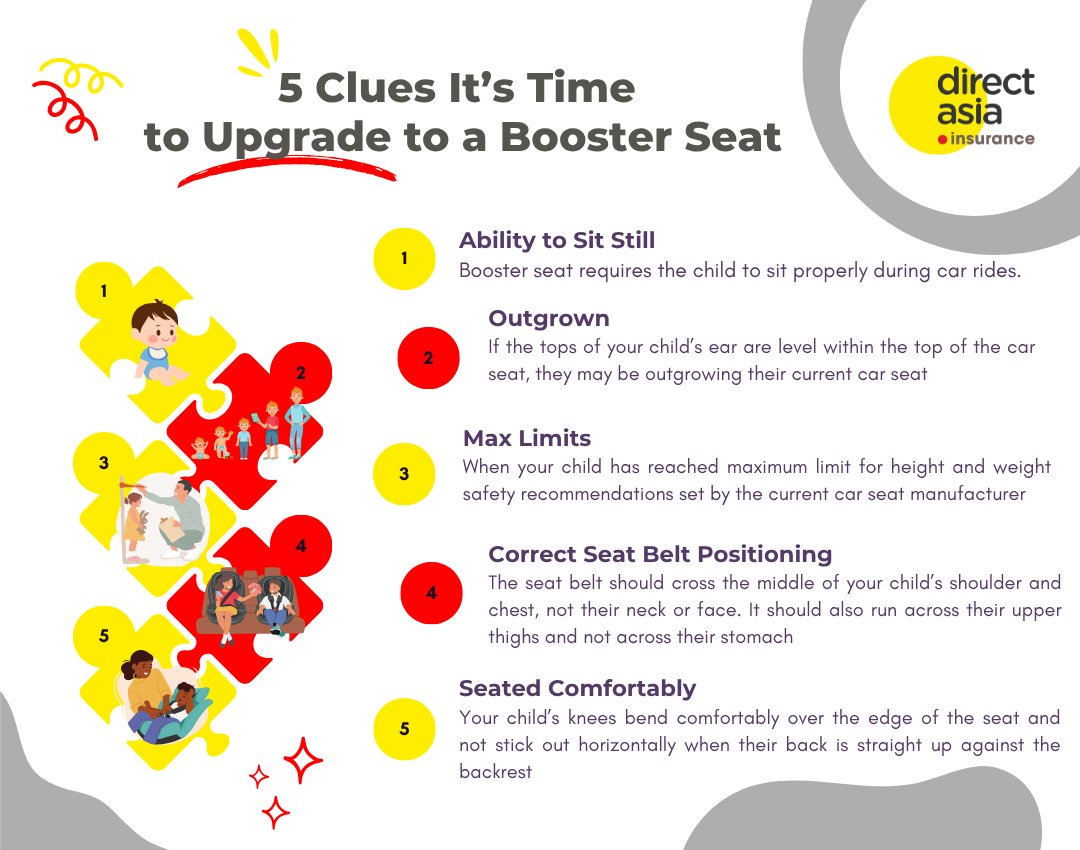
5 Clues It’s Time to Upgrade to a Booster Seat
Despite general suggestions of height, weight or age, the decision to move your child to a booster seat meant for older children really depends on your individual child. Here are 5 pointers to tell it’s time:
5 Times You Need to Replace Your Car Seat
Car seats are not a one-time purchase that will last forever. Follow these tips to tell when your car seat may need to be replaced:
Check the expiration date
All car seats have an expiration date, either on an affixed sticker or printed on the car seat itself. A car seat “expires” because of the degradation of materials and evolving safety standards.
After a crash
You should replace your child’s car seat after an accident, even if there is no visible damage. The forces involved in a crash can compromise the integrity of the car seat’s effectiveness and safety.
If it’s worn out
Cracks and dents to the plastic, fraying or torn harness straps, or padding that no longer holds your child in place are all reasons to toss the old one out and get a new car seat.You can reuse a car seat from your older child for your younger child as long as it isn’t past the expiration date and is still in good condition.
If it’s recalled
Manufacturers sometimes recall car seats if they are deemed unsafe, so make sure you register your car seat with the manufacturer to receive any recall notices.
From unknown sources
If you’re unsure of the origins of the car seat you’ve been gifted, or if it was a hand-me-down without proper documentation, don’t take the risk. Knowing that the integrity of the car seat your child is in has never been compromised will give you more peace of mind.
For this reason, it’s not recommended to buy a second-hand car seat.
Do You Need a Car Seat in Taxis or Ride-Sharing?
Taxis: No
Legally speaking, the Road Traffic Act actually does not apply to taxis and buses, except school buses.
However, for safety reasons, parents may choose to look into lightweight and portable car seats, or adjustable seat belt adaptors to take along with them when heading out. Children should always ride in the rear of a taxi instead of the front seat for extra precaution.
As SingHealth puts it: “Taxis are exempt from this legal requirement, but they are not exempt from the laws of physics!”
Ride-Sharing: Yes
Because Grab, Gojek and other similar ride-sharing services are actually private vehicles, they are not exempt from Singapore’s car seat regulations. You MUST use appropriate child restraint, or you’ll be deemed breaking the law. This responsibility falls on the parents and not the driver.
The good news is that there are options such as GrabFamily (Ages 1-3), GrabFamily (Ages 4-7, 4-seater) GrabFamily 6 (Ages 4-7, 6-seater), which offer the appropriate car seats for children of such ages.
Just earlier this year in 2024, Gojek introduced their own GoCar Kids (4-seater) and GoCar XL Kids (6-seater) for kids aged 4-7.
The bad news is that if you have two kids of different ages, you’ll either have to take a taxi, split rides, or choose GrabFamily (Ages 1-3) for the more bulky infant/toddler car seat, and bring along a more portable booster seat for your older child. Another alternative is to bring along a safety vest which is a wearable child restraint.
Note that some drivers will NOT accept rides where there are more than one child present without an appropriate child restraint system. (But some GrabFamily drivers may have two booster seats on board, check with them first!)
With all this knowledge on car seats and booster seats, you’ll be able to keep your kids safe at all times, whether riding in your own car or when flagging down a ride. Just remember, strap in and stay safe!


